
Emily lent her coworker Jake $1,200 for a car repair. They agreed on "about $200 a month." Four months later, Jake was sure he'd paid $800. Emily's count was $600. Neither was lying: one payment had been made in cash at a team lunch, and nobody wrote it down.
A short IOU and a running payment log would have settled that in ten seconds. Neither takes long to set up, and you don't need a lawyer to write one for a small personal loan between people who trust each other.
What an IOU is (and what it isn't)
An IOU is a short, written acknowledgment that one person owes another a specific amount of money. For casual loans between friends, coworkers or family, it does two jobs: it makes the terms clear before anyone forgets them, and it gives you both one record to check against later.
It is less formal than a promissory note, which usually spells out interest, what happens on default and other legal terms. If you're lending a large amount, charging interest, or lending to someone you don't know well, look into a proper promissory note and consider asking a professional. Rules differ by state and country, and nothing in this article is legal or tax advice.
The IOU template
Copy this, change the details, and keep a copy each:
IOU
Date: October 3, 2026
I, Jake Miller, have borrowed $1,200 from Emily Park.
Purpose: car repair.
Repayment: $200 on the 1st of each month, starting November 1, 2026, until paid in full (6 payments).
Interest: none.
Payments sent by: bank transfer. Cash payments get a quick text to confirm.
If a payment is going to be late, I'll let Emily know before the due date.
Signed: Jake Miller, Emily Park.
That's it. Nine lines, and every one of them earns its place.
What each line is for
Date and names
Use full names. "Jake" is fine in your phone, but a year from now, "Jake Miller" is much clearer. The date also anchors every deadline that follows.
The exact amount
Write the number in digits. If the loan was paid out in more than one transfer, note the total and add the transfers as the first entries in your payment log.
Purpose
This line feels optional, but it helps memory. "The $1,200 for the car repair" is much easier to recall than "that loan in October."
Repayment terms
This is the line people most often leave vague. Pick one of these and write it down:
- One payment by a date: "in full by December 15, 2026."
- Installments: "$200 on the 1st of each month, 6 payments."
- Open-ended: "whenever possible, with at least $50 a month." Be honest that this one is the easiest to let slide.
If you're charging interest, the schedule gets more involved. Our guide to how a loan repayment schedule works walks through the common methods with real numbers.
Interest
Write "none" if there's none. Leaving it blank invites confusion later. In the US, larger loans with little or no interest can have tax implications, so for big amounts it's worth a quick conversation with a tax professional.
How payments are made
Bank transfer, cash, a payment app: say which. Cash is where most disagreements start, so agree that every cash payment gets a quick confirmation text.
What happens if a payment is late
Keep it human. You're not drafting a contract with penalties; you're agreeing that the borrower will speak up before a missed payment instead of after.
The part everyone forgets: the payment log
The IOU covers the start. The payment log covers everything after. Every time money comes back, add a line with the date, the amount and what's left:
- Nov 1: $200 paid, $1,000 left
- Dec 1: $200 paid, $800 left
- Dec 20: $200 cash at lunch, $600 left (confirmed by text)
- Jan 2: $200 paid, $400 left
That third line is exactly the one Emily and Jake were missing. With it, both counts land on $800 paid and $400 left, and there's nothing to argue about.
Where to keep it
- Paper: sign two copies and take a photo of yours. Paper gets lost, so the photo matters.
- A notes app: quick and always with you, but easy to edit by accident and hard to share cleanly.
- A spreadsheet: great for one loan, tedious once you have several people and partial payments.
- A debt tracking app: built for this, so the remaining balance updates itself.
Keep your IOUs in Tivelis
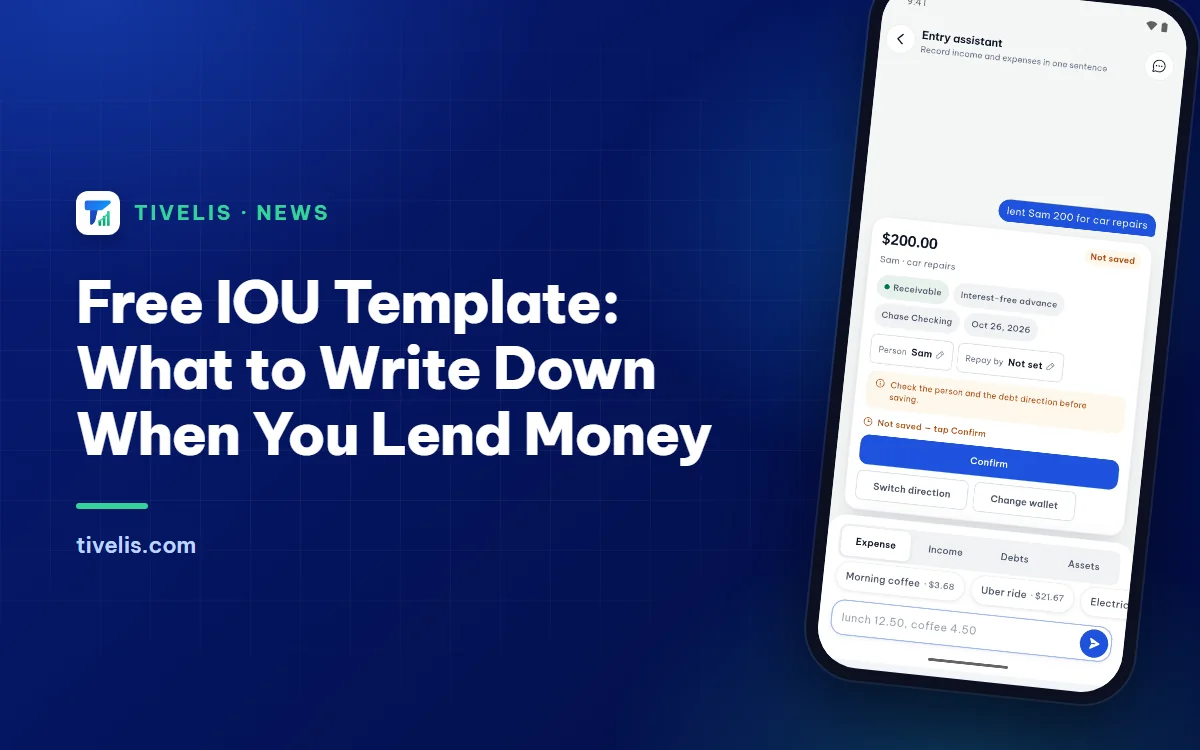
Tivelis has a debt book that covers both halves: the IOU and the payment log. Create the debt from the Debts tab with the person, the amount, the date and a due date, or just type "Jake owes me 1200". Attach a photo of the signed IOU so it lives right next to the numbers.
Each time money comes back, type "Jake paid me back 200" or add the payment from the debt itself. Tivelis records it with the date and recalculates what's left, so your log writes itself. Turn on Debt due reminders in Settings and you'll get a heads-up one day before the due date, on the day, and once it's overdue.
When you want to check that you both agree, use Share to compare notes: send a clean image card, or a private tivelis.com/n/... link that always shows the latest numbers. The borrower can open the link in any browser without installing anything. Your note on the debt stays hidden unless you choose to include it, and Tivelis never messages anyone for you. New accounts get every feature free for 30 days. After that, the Free plan keeps your records and the main features, with a limit on how many debts can be open at the same time. If it's time to bring up a late payment, our guide on how to ask a friend to pay you back has message templates.
Get Tivelis and turn your next IOU into a record you both can see.