
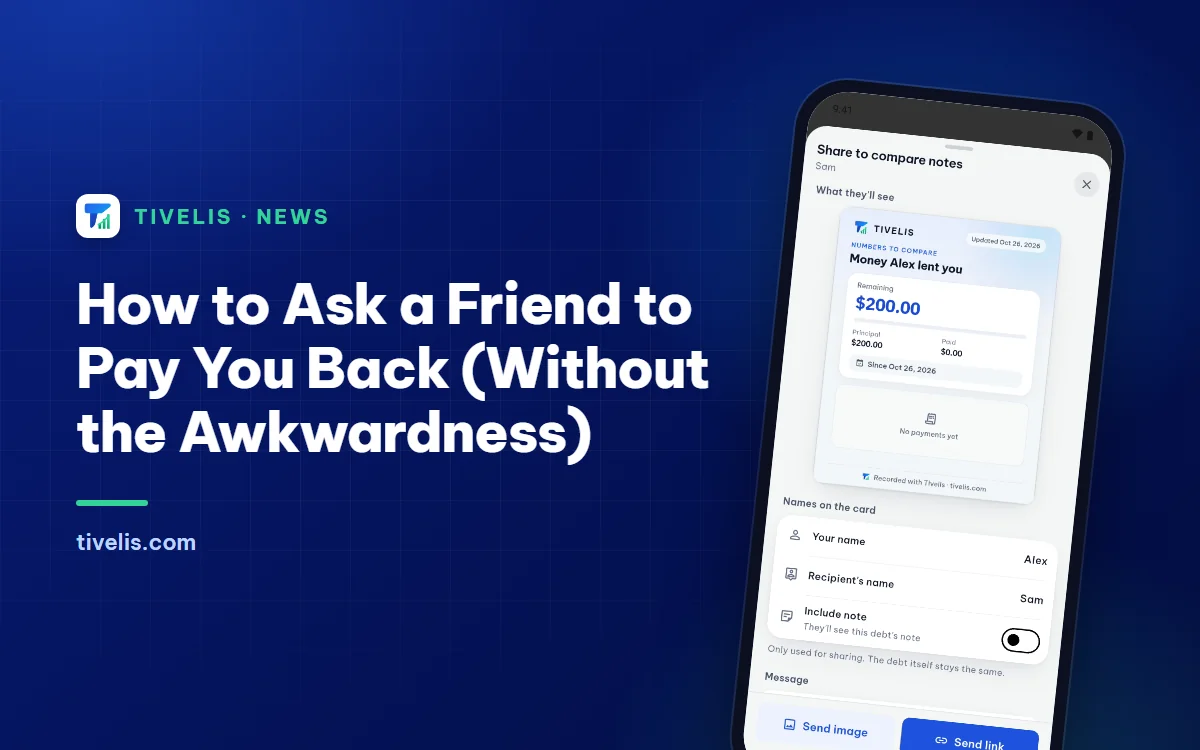
Back in June, your friend Jake asked to borrow $300 to cover the rest of his rent. "I'll pay you back at the end of the month," he said. It's now October. He has posted photos from two concerts since then, and you've opened your messages to write to him three times, then closed the app because you couldn't find the right words.
If that sounds familiar, you're in good company. Most people who borrow from friends aren't trying to dodge the debt. They got busy, they remember a different number, or they assume you're not in a hurry. Your job is to make the ask clear, polite and easy to say yes to.
Why asking a friend for money back feels so hard
With a stranger, you'd just send an invoice. With a friend, a coworker or a cousin, three fears get in the way: looking petty, making things awkward, and getting the number wrong.
That last one gets overlooked, but it causes the most trouble. If you say "you still owe me $300" and Jake remembers sending you $100 in August, the conversation stops being about paying you back and turns into an argument about who's right. So before you send anything, make sure your numbers are solid.
Get three things ready before you ask
- The exact numbers: the original amount, every payment so far (date and amount), and what's left.
- The timeline: when you lent the money and the date you originally agreed on.
- A flexible option: would you take one payment, or would two or three smaller ones be fine?
If those details are scattered across old texts, bank statements and your memory, pull them into one place first. Our IOU template guide lists exactly which details are worth writing down so you never have to dig for them again.
Five ways to ask without hurting the friendship
Pick the right moment
A few days after payday usually works best. Avoid late-night messages, moments right after they've told you about a rough week, and group chats of any kind.
Talk about the numbers, not the person
"Why haven't you paid me yet?" is about Jake. "Here are the numbers from June so we're on the same page" is about the money. When you're both looking at the same figures, it's much easier for the other person to respond without feeling accused.
Offer to split it up
Paying $200 in one go might be a stretch. Paying $100 a month for two months is easy to agree to. If you suggest the smaller payments yourself, your friend doesn't have to ask for more time.
Leave them a graceful way to reply
Write so they can answer without losing face: "Let me know if anything looks off" or "If this month is tight, we can work out a schedule." People who feel respected are more likely to follow through.
Keep it private, steady and direct
Don't ask a mutual friend to pass the message along, and don't drop hints on social media. Calling someone out in public can backfire badly, and it rarely gets you paid faster. If you don't hear back, wait about a week and follow up once, in the same friendly tone.
Message templates you can copy
Change the names and numbers to fit your situation:
Hey Jake, sending over the numbers from the June loan so we're on the same page: $300 total, you paid $100 on Aug 20, so $200 left. Let me know if anything doesn't match what you have.
Hey Jake, about the $200 that's left, would it work to send $100 this month and the rest in November?
I'm tidying up my money stuff before the holidays, so here's the one from June. Could you check that this matches your records?
Notice that none of these use the words "owe" or "debt". They state the numbers and the dates, then invite the other person to confirm.
Say Jake writes back that he remembers paying $150, not $100. Because you sent dates and amounts, you can check together: maybe there was a $50 cash payment neither of you wrote down. Either way, you are now sorting out a number together, not arguing about whether he plans to pay.
What not to do
- Bring it up in front of other people, at work or in a group chat.
- Threaten to "tell everyone" or post screenshots of the conversation.
- Add late fees or interest you never agreed on.
- Send several reminders in a single day.
If you've asked politely a few times and get total silence on a large amount, it may be time for a face-to-face conversation, or to look into the small claims options where you live. For small amounts, many people decide to treat it as a lesson and simply don't lend again.
Share the numbers with Tivelis
The hardest part of asking for money back usually isn't the wording. It's having clean numbers to point to. Tivelis has a debt book built for exactly that.
You record the loan with one sentence like "Jake owes me 300", or use the form in the Debts tab to add a due date. Each time Jake pays some back, type "Jake paid me back 100" and Tivelis logs the payment and updates what's left. If you turn on Debt due reminders in Settings, the app reminds you one day before the due date, on the day itself, and once the debt is overdue.
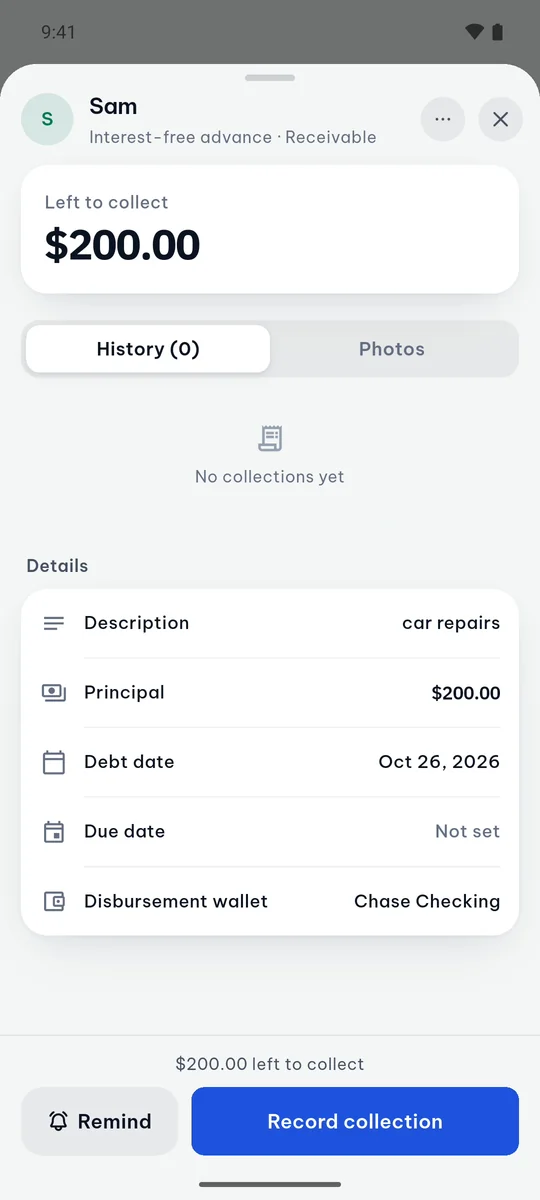
When it's time to follow up, open the debt, tap the "..." menu and choose Share to compare notes. You can send it two ways:
- Send image: Tivelis creates a clean card with both names, the original amount, what's been paid, what's left, the due date and recent payments. Share it through any messaging app on your phone. It works even offline.
- Send link: your friend opens a page at tivelis.com/n/... in any browser, with no app or account needed. The page always shows the latest numbers, so when Jake pays more and you log it, the page updates too.
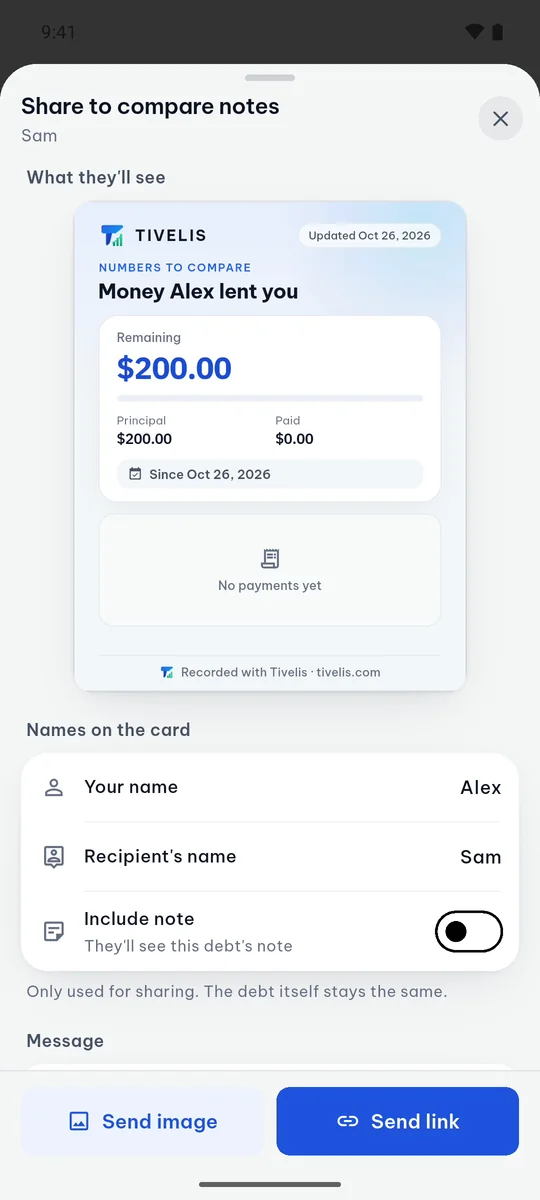
Tivelis suggests a neutral message, "Hi Jake, sharing our numbers so we're in sync", which you can edit before sending. The debt's note stays hidden unless you turn on Include note. Links expire after 60 days, and you can turn a link off or create a new one at any time. Sharing is free on every plan. New accounts get every feature free for 30 days. After that, the Free plan keeps your records and the main features, with a limit on how many debts can be open at the same time.
One thing to be clear about: Tivelis never messages anyone for you. Every message is sent by you, when and how you choose. If the person you lent to is family and you want a system rather than a one-off, read lending money to family without the drama.
Get Tivelis and log your first IOU. Next time you need to follow up, just send the numbers.