
Two loans can both say "6% interest, 12 months" and still cost very different amounts. On a $6,000 loan, the total interest can be about $195 or $360, depending on one detail most people skip: how the interest is calculated each month.
That detail lives in the repayment schedule, the table that shows every payment, when it's due, and how much of it goes to interest versus the amount you borrowed. Once you can read one, you can compare any loan offer, or set up a fair one between friends.
This article is general information to help you understand the math. It isn't financial advice and it doesn't recommend taking on any loan.
The four numbers behind every schedule
- Principal: the amount borrowed. In our examples, $6,000.
- Interest rate: the yearly rate, here 6%. Monthly schedules use one twelfth of it, 0.5% per month.
- Term: how long repayment takes, here 12 months.
- Method: how interest is charged and how principal is paid down. This is where schedules differ.
Every row in a schedule answers the same questions: what's due this month, how much is interest, how much reduces the principal, and what's left afterward.
Method 1: equal monthly installments (amortized)
This is the method behind most car loans and mortgages. You pay the same amount every month. Early payments are mostly interest; later ones are mostly principal, because interest is charged on a balance that keeps shrinking.
For $6,000 at 6% a year over 12 months, the payment is $516.40 a month:
- Month 1: interest $30.00 (0.5% of $6,000), principal $486.40, balance $5,513.60
- Month 2: interest $27.57, principal $488.83, balance $5,024.77
- Month 3: interest $25.12, principal $491.28, balance $4,533.49
- Month 12: interest $2.57, principal $513.82, balance $0 (final payment $516.39)
Total interest is $196.79. The last payment is one cent lower to absorb rounding, which is common.
The appeal is predictability: one number to budget for, every month.
Method 2: declining balance with equal principal
Here the principal is split evenly, $500 a month, and interest is charged on whatever is still owed. So payments start higher and shrink every month.
- Month 1: $500 principal + $30.00 interest = $530.00
- Month 2: $500 principal + $27.50 interest = $527.50
- Month 6: $500 principal + $17.50 interest = $517.50
- Month 12: $500 principal + $2.50 interest = $502.50
Total interest: $195.00, slightly less than the amortized version because you pay principal down faster at the start. The trade-off is that the first payments are the heaviest.
Method 3: flat rate
A flat rate charges interest on the original amount for the whole term, even as you pay it down. That makes the math simple and the payments equal, but it costs more.
- Interest: $6,000 × 6% × 1 year = $360
- Total to repay: $6,360
- Payment: $6,360 ÷ 12 = $530.00 a month
Total interest: $360, almost double the amortized loan at the same quoted rate. Converted to the equivalent rate on a declining balance, a 6% flat rate over 12 months works out to roughly 10.9% a year. That's why it's worth asking which method a "6%" quote uses.
Method 4: interest-only, principal at the end
You pay only interest each month and the whole principal in the last payment.
- Months 1 to 11: $30.00 each
- Month 12: $30.00 + $6,000 = $6,030.00
Total interest: $360, because the full $6,000 stays outstanding the entire year. Monthly payments are tiny, but the final one is a big event that needs planning.
Side by side
The same $6,000, 6% a year, 12 months:
- Equal installments: $516.40 a month (last one $516.39), $196.79 interest.
- Declining balance: $530.00 down to $502.50, $195.00 interest.
- Flat rate: $530.00 every month, $360.00 interest.
- Interest-only: $30.00 a month, then $6,030.00, $360.00 interest.
What about loans between friends and family?
Most personal loans between people who know each other have no interest at all, which makes the schedule simple: the amount divided into equal payments. $1,200 over six months is $200 a month. If you do agree on interest, use this article to agree on the method too, so "5%" means the same thing to both of you. Our guide to lending money to family covers how to set terms that actually get kept, and the IOU template shows how to write them down.
Here is how that can play out. Say a friend lends you $6,000 at "6%" over a year. You assume equal monthly installments and expect about $197 in interest. Your friend means a flat rate and expects $360. Nobody is being unfair, but one of you is in for a $163 surprise. Agreeing on the method up front avoids it.
Reading any schedule: a quick checklist
- Which method is used? Ask directly if it isn't stated.
- What is the total interest over the full term, not just the rate?
- Is the last payment different from the others?
- What happens if you pay early: does the interest go down, or is it fixed?
- Are there fees on top of the interest?
Try the numbers yourself
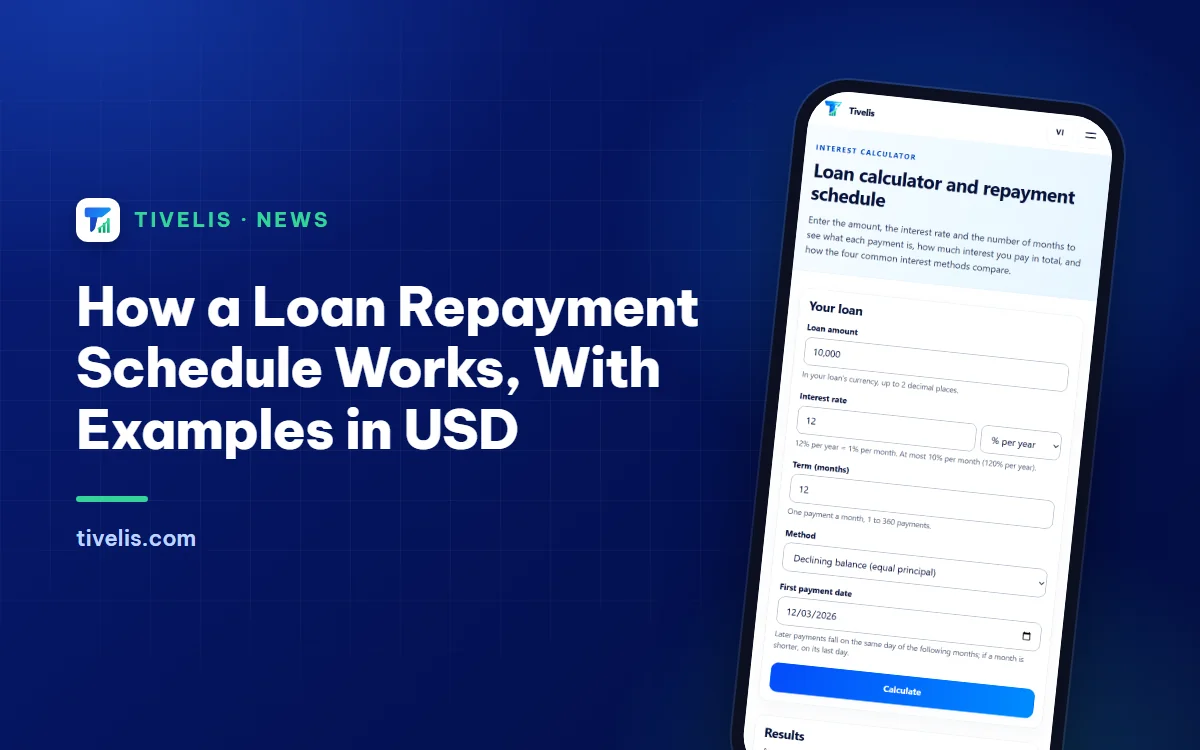
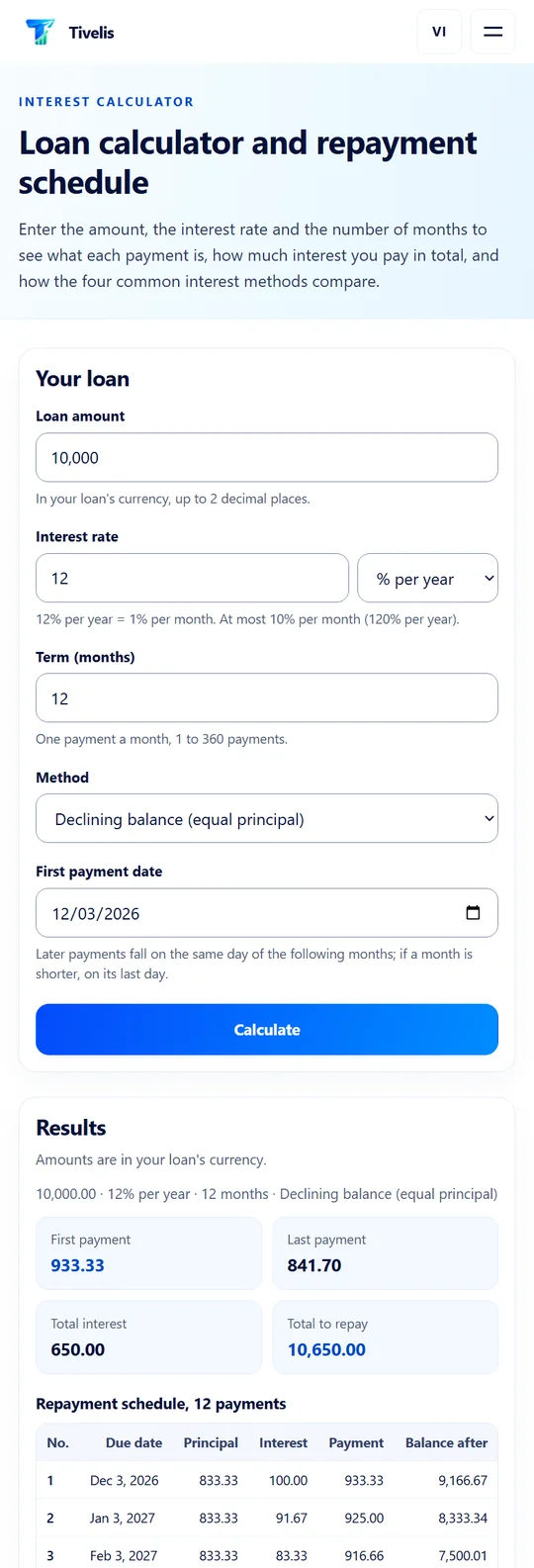
The free loan repayment calculator on tivelis.com lays out a full schedule for each of these four methods. Plug in your own amount, rate and term, and it compares the methods side by side.
Keep track of a personal loan in Tivelis
If you lend or borrow with interest, Tivelis can track it for you. In the loan form, choose the method (equal monthly installments, declining balance, flat rate or interest-only), the rate and the term, and the app lays out every installment with its due date and the split between principal and interest. Log a payment and Tivelis applies it to the schedule and shows what's left.
You can also share the numbers with the other person. Share to compare notes sends a clean image card or a private tivelis.com/n/... link, and for installment loans both include the payment schedule. The link always shows the latest numbers and opens in any browser, no app needed. With Debt due reminders on, you get a reminder one day before each due date, on the day, and once a payment is overdue. New accounts get every feature free for 30 days. After that, the Free plan keeps your records and the main features, with a limit on how many debts can be open at the same time.
Get Tivelis to keep a personal loan and its schedule in one place.