

Your brother Chris calls on a Sunday night. His car's transmission is done, the repair is $2,400, and he needs the car to get to work. You have the money. Of course you're going to help. The question is how to do it so that, a year from now, you're still talking about football at Thanksgiving and not about the $2,400.
Family loans go wrong for predictable reasons: nobody said out loud whether it was a gift, the repayment plan was "whenever," and each side kept a different number in their head. None of these is hard to fix. You just need a system, and it fits on one page.
Step one: decide if it's a gift or a loan
Before anything else, be honest with yourself. If you'd be fine never seeing the money again, call it a gift and say so. A gift that's secretly a loan is the worst of both worlds: you feel owed, they feel free, and resentment fills the gap.
If it is a loan, use a simple test for the amount: lend only what you could live without if it never came back. Not because your family is unreliable, but because life happens. Jobs change, kids get sick, cars break again. If losing $2,400 would put your own rent at risk, lend less, or help in another way.
Step two: agree on the terms out loud, then write them down
Talk through four things on the phone or in person, then put them in a text or a short note so both of you have the same version:
- The amount: $2,400.
- The schedule: $200 a month for 12 months, starting next month.
- Interest: most family loans have none. If you do charge interest, agree on the method now, not later.
- What happens if a month is tight: "Tell me before the payment date and we'll push it back a month."
Writing it down isn't a sign of distrust. It protects the relationship from memory. Our free IOU template has a version you can copy in two minutes.
Step three: make the schedule fit their life
A schedule your brother can actually keep beats a faster one he can't. If Chris gets paid on the 15th, set payments for the 17th, not the 1st. If his income is uneven, agree on a minimum and let him pay more in good months.
Smaller, regular payments also keep the loan visible without anyone having to bring it up. Twelve payments of $200 feel like a routine. One payment of $2,400 "sometime next year" feels like a cloud.
Step four: keep one record you both trust
This is where most family loans quietly fall apart. You remember $800 paid back. He remembers $1,000, because he's counting the $200 he gave you in cash at your mom's birthday. Both of you are sure.
Keep a single record with the date and amount of every payment, and make it easy for the other person to see. When both sides look at the same numbers, there's nothing to argue about, and you never have to say "I think you still owe me..." at the dinner table.
Step five: plan for the missed payment
Sooner or later a month will slip. Decide in advance how you'll handle it so you don't react in the moment:
- One missed payment: a friendly check-in a few days later, focused on the numbers, not on blame.
- A rough patch: pause payments for a month or two and move the end date. Update the record so it still reflects reality.
- A permanent change: if they truly can't repay, you can turn the rest into a gift. Say it clearly, so it's closed for both of you.
If you need help with the wording, our guide on how to ask a friend to pay you back has message templates that work just as well with family.
When you're the one borrowing
The same system works in reverse. Say you borrowed $1,500 from your dad to cover moving costs. Write down the amount and the plan, pay on the dates you promised, and log every payment, including the $100 you handed him at lunch. Then send him the numbers every few months. Parents rarely ask, but most of them appreciate knowing where things stand, and it keeps the loan from becoming the topic nobody mentions.
How Tivelis fits into this system
Tivelis keeps both directions in one debt book: money you lent and money you borrowed. Record a loan with a sentence like "Chris owes me 2400" or "borrowed 1500 from Dad", or use the form in the Debts tab to add dates, a due date and a photo of anything you wrote down together.
Each payment takes one line, like "Chris paid me back 200". Tivelis logs it and updates what's left. If you agreed on interest, the loan form lets you choose equal monthly installments, a declining balance, a flat rate or interest-only, and shows every installment with its due date. Turn on Debt due reminders in Settings and the app reminds you one day before a due date, on the day, and once it's overdue. The reminders go to you, not to your family.
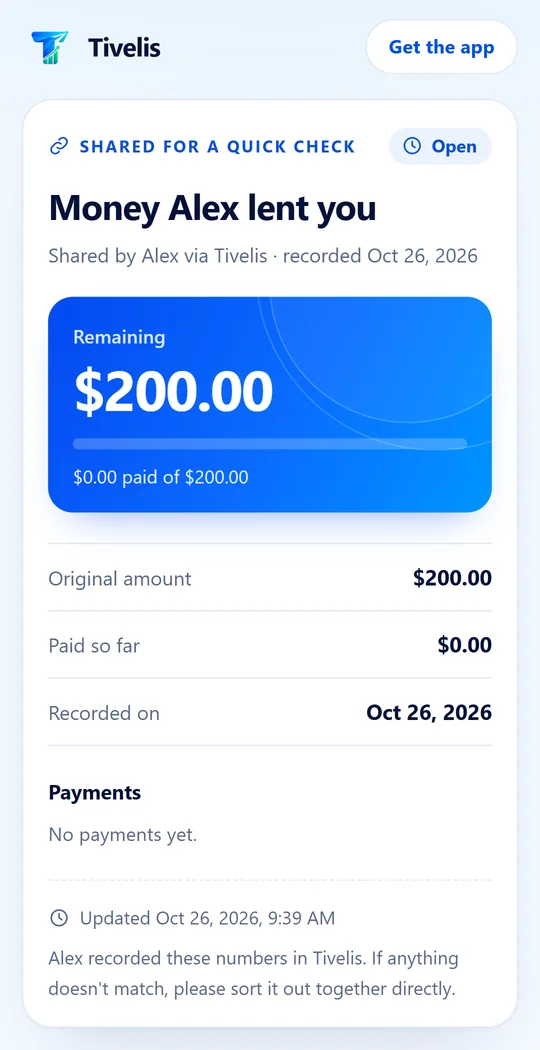
When it's time to check in, choose Share to compare notes from the debt's menu. Send a clean image card, or a private link your family can open in any browser without installing anything. The page always shows the latest numbers, and for installment loans it includes the payment schedule. Your note stays hidden unless you include it, links expire after 60 days, and you can turn a link off at any time. Sharing is free on every plan. New accounts get every feature free for 30 days. After that, the Free plan keeps your records and the main features, with a limit on how many debts can be open at the same time.
Get Tivelis and set up your next family loan so the only thing anyone argues about at dinner is football.